S Corp Requirements AlternativeWho may own it.
Someone offered to buy a piece, or a trust already holds some, and you are not sure the election still fits.
See the owners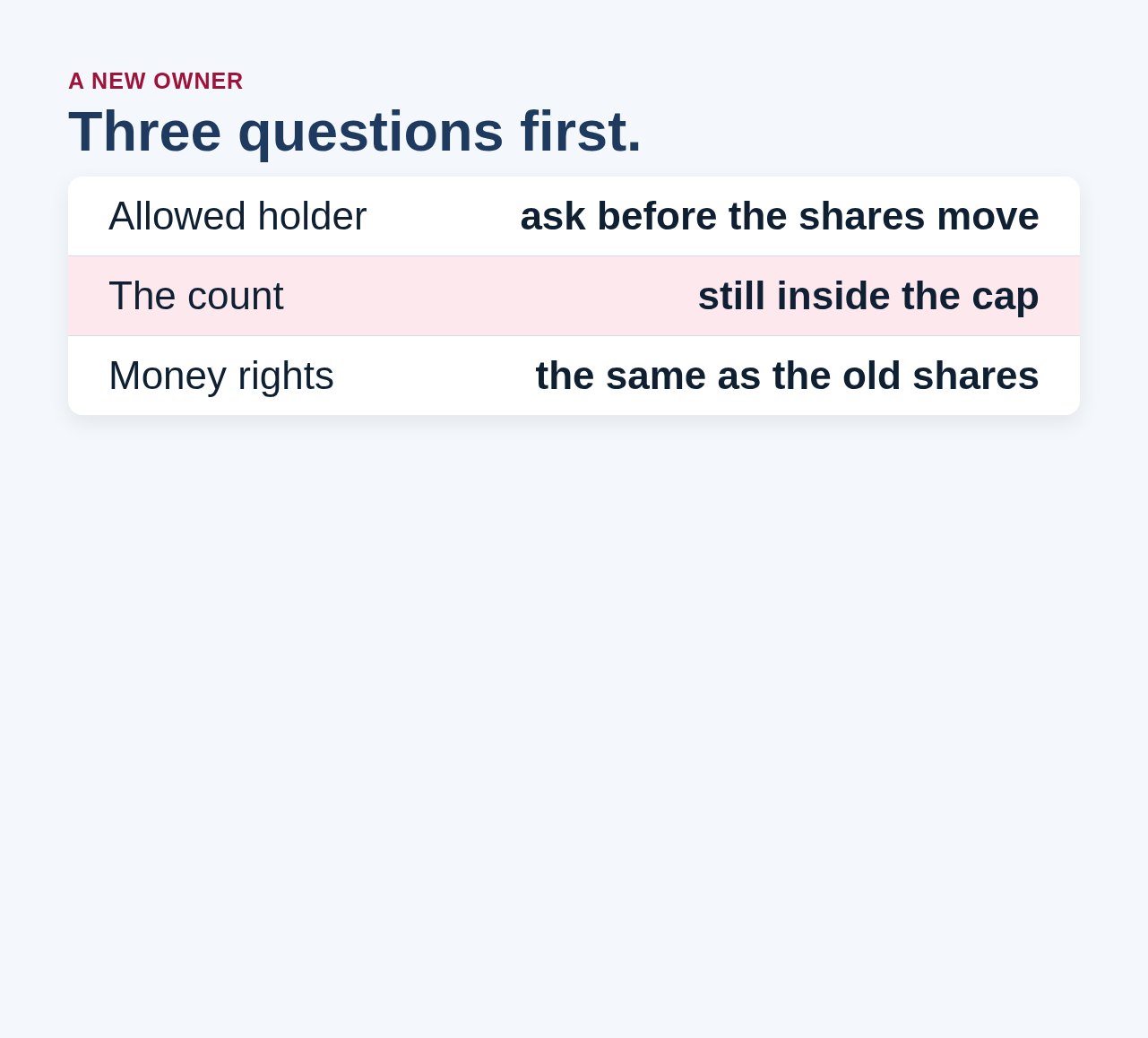
People, trusts, and the names that do not fit.
Click to see the names ›Tap to see the names ›
You are looking at a new name on the cap table and wondering if that name ends the election. Start with the cap table as it exists this month, not as it existed when the company was formed. Write every name that holds shares, and the kind of holder that name is. A living person is the ordinary case. An estate can hold shares for a time after a death. Some trusts can hold shares, and many trusts cannot. We do not guess from the title of the trust. We read the trust against the list the statute already published.
A partnership as a shareholder is a stop. A corporation as a shareholder is a stop. A person who is not allowed to hold the stock is a stop. That stop decides whether the election is still alive or has already ended. A new name on the cap table is read in the month the shares move, while the return is still months away.
The count, and the family election.
Click to see the count ›Tap to see the count ›
One hundred is the published cap. Counting to one hundred sounds simple until a family has several holders and someone remembers a rule that treats them as one. That treatment is an election of its own. It is not the default. If the family wants it, the election has to be made, and the names it covers have to be the names on the stock. We write both.
A transfer to a spouse, a child, or a trust can change the count even when everyone thinks of it as the same family money. We ask for the transfer document in the month it is signed. We update the count. We say whether the next transfer still fits under the cap the statute printed, and we write that count in the month file.
One class, with voting that can still differ.
Click to see one class ›Tap to see one class ›
One class of stock means the economics match. Every share of that class gets the same distribution per share, and the same claim if the company is sold or wound up. Voting can be different. A voting share and a nonvoting share can still be one class when the money rights match. We draw that distinction in ordinary words and we hold the documents up to it.
The document that breaks the class is often not called a class. It is a side letter, a bonus that only one owner receives and that is not wages, or a preferred return written into an operating deal the company should not have. We read those pages. If the money rights differ, we say the election is at risk and we stop calling the stock one class. Repair, if a repair exists, is a separate conversation with the facts in hand.
What we do with a new owner.
Click to see a new owner ›Tap to see a new owner ›
A new owner changes the requirements in the month the shares move, and the worry is that March will be the first time anyone notices. Before the shares move we ask three questions. Is this holder allowed. Does the count still fit, with or without a family election that is actually on file. Do the new shares carry the same money rights as the old ones. The answers go in the month file. The election copy stays in the same folder.
If any answer is no, we do not paper over it with a K-1 in March. We tell you the election is the thing at risk, and we tell you whether this practice can still keep the list or whether you need a different kind of help. The first call exists so we can say that stop out loud. Bring the cap table. Bring the side letters. We will read them against the list on this page.
Name the paper you are holding.

You will be talking to the Steven Palmieri practice.