S Corp Requirements AlternativeThe owner wage.
Someone told you to pay yourself a salary and you have never run payroll.
See the wage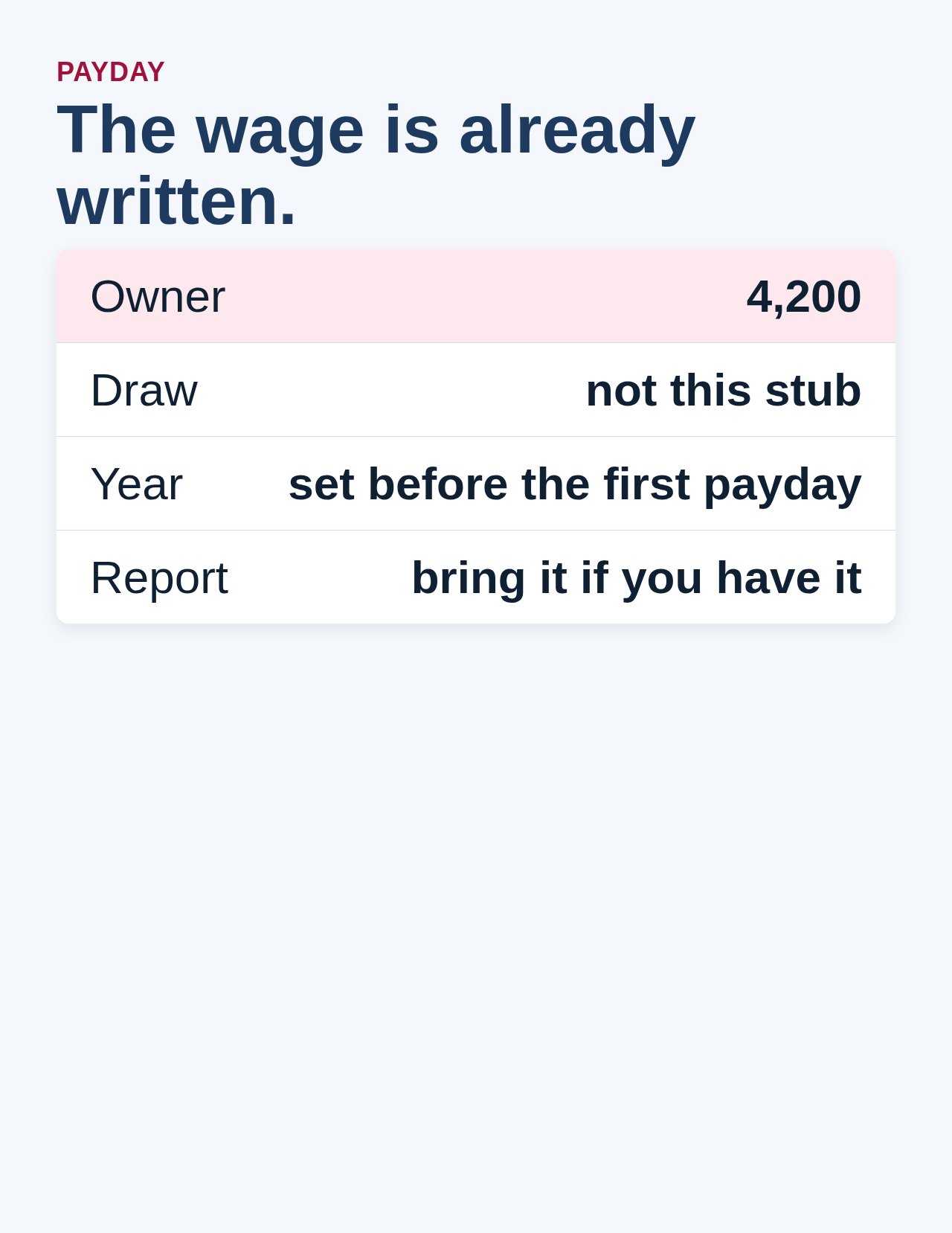
Work is a wage. Ownership is a draw.
Click to see the wage ›Tap to see the wage ›
You have been moving money to yourself and you are afraid none of it was a paycheck. If you work in the company, the pay for that work is wages. The payroll company you already use should be the one that runs the paycheck. This practice does not send the paycheck and does not sit inside that payroll system as the employer of record. We do tell you, before the first payday, what the wage for the year needs to be so the draw is not doing the job of the wage.
A year of large transfers and no W-2 is the pattern we will not call ordinary. The transfers may be distributions. They are not a substitute for pay. The requirement is that the owner who works takes a real wage for the work, and that the wage is decided while the year can still be paid that way. December is a hard month to invent a year of payroll. January is the month we would rather have the number.
Reasonable is the work, written down.
Click to see the work ›Tap to see the work ›
Reasonable compensation is the pay the work would draw from a person who was not an owner. The duties matter. The time matters. The company cash matters. A wage the bank account cannot pay will not go out, so we pick a wage the account can cover. We write a short duty list and a wage beside it. We do not copy a percentage from a blog and call it the rule. There is no single percentage on this page because a single percentage would be a fiction.
We also look at what the owner used to pay a manager for the same duties, or at what the company pays other people for overlapping work. Those are facts. A round number chosen because it feels small enough to keep the tax down is not a fact. If that is the only number on the table, we say so, and we ask for the duties before we write anything next to them.
The payroll boundary.
Click to see payday ›Tap to see payday ›
Payday stays on the payroll company. We set the figure and the reason. You, or the payroll company you run, produce the paycheck and the filings that go with a paycheck. When an agency asks for payroll records, the answer is the record that agency named. We do not step into an examination of those filings as part of the requirements work.
The W-2 at the end of the year should match the wage we wrote down. If the year changed, the wage can change, and we write the change in the month it changes. A silent change, visible only when the W-2 arrives, is the change we try to prevent. The six papers on the home include that W-2 because it is the proof the wage was real.
Bring the last paycheck and the duties.
Click to see the paycheck ›Tap to see the paycheck ›
On the first call we want the last pay stub or the last payroll report, and a plain description of what you do in the company each week. If there has been no paycheck, say that. It is a better start than a rounded story. We will tell you whether a wage can still be set for the year you are in, or whether the year has to be read as it was.
The paid work of setting the wage and tying it to the closed months starts only after a scope is signed. The note you send here names the year and whether a paycheck exists. That is enough for us to know which requirement you are unsure of.
Name the paper you are holding.

You will be talking to the Steven Palmieri practice.