S Corp Requirements AlternativeThe March return.
The company return is due and you are not sure the year was ever closed.
See March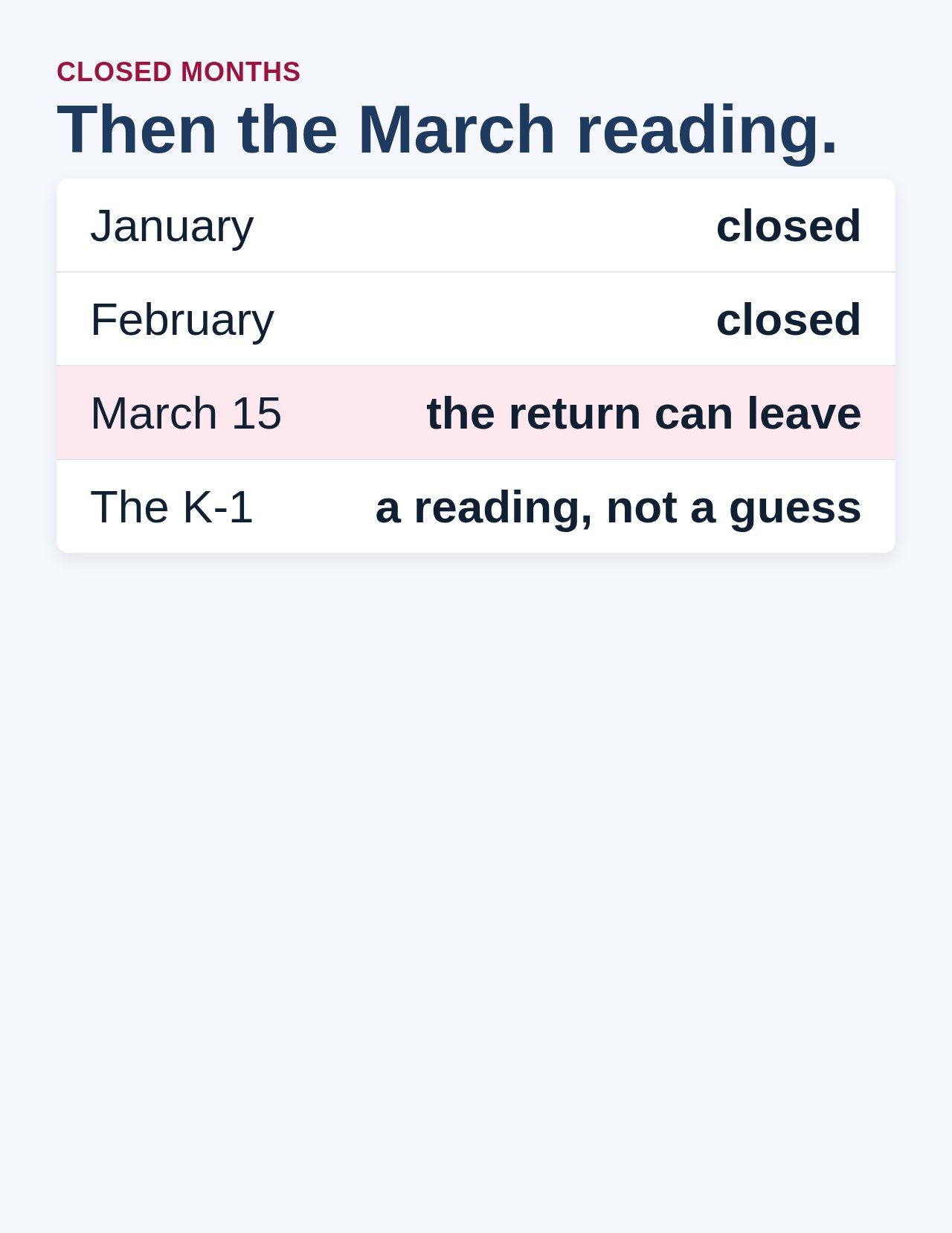
15 March is a calendar-year day.
Click to see March ›Tap to see March ›
The date is close and you cannot name a month that matches the bank. A company that keeps the calendar year files its S corp return on the 15th day of the third month. That day is 15 March. The K-1s go with it. A company with a different year uses the 15th day of its own third month, and we do not force that company onto 15 March. The first question is which year the company keeps. The date follows the year.
March can only read months that already match the bank. If January through the last month of the year are not tied to the bank, we do not type a profit to meet the day. We say the months are open. An extension can move the filing date. People confuse that with closing the year. The extension does not reconcile the bank. It does not create basis. It does not decide the wage. It moves a deadline.
What has to be true before the return leaves.
Click to see the return ›Tap to see the return ›
The election is on file for the year the return covers. The owners on the K-1s are the owners who actually held the stock. The wage for the owner who worked is in the payroll, not parked in a distribution with a new name. The draws are labeled. Basis has been updated through the last closed month. Those are the requirements arriving at the same table. A return that skips one of them is a return we will flag before it is filed.
The 1120-S is typed from the closed-month file we already built. We do not prepare it from a stack of bank pages that nobody has summed. If the close is the work that has to happen first, we say that on the first call. Some companies need the months closed before a return is even a responsible draft. We would rather do the close, or stop, than ship a draft that looks finished.
The K-1 is one page per owner.
Click to see the K-1 ›Tap to see the K-1 ›
Each owner receives a K-1 that states that owner's share of the closed year. The owner uses it on the owner's own return. We do not mix the company return and the owner's personal return into one undifferentiated pile. The K-1 travels from the company filing to the owner's filing, and those filings stay separate. The company return is the 1120-S. The owner still has a separate filing. The reply tells you whether we mean the company filing or your own filing, whichever you asked about.
A K-1 built in a weekend from open months is the document this site exists to prevent. The work that makes the K-1 honest is the monthly close. March is the reading. If you are arriving in March with a year that was never closed, the honest sentence is that the return is waiting on the months. We will help you see how far back the open months go.
Bring the last closed month.
Click to see the month ›Tap to see the month ›
Tell us the last month that matches the bank, and whether a payroll report exists for the owner. That pair of facts tells us whether 15 March is a filing date you can meet with a real return or a date that needs an extension plus a close. Both answers are useful. A vague promise that the books are mostly fine leaves the month open. We still have to close it.
The button on this page sends that pair. It does not file the return. Filing is the paid work, after the scope names the year, the close, and the price. Until that page is signed, we are reading the list with you.
Name the paper you are holding.

You will be talking to the Steven Palmieri practice.