S Corp Requirements AlternativeQuestions before you send the note.
You have one worry and you want a plain answer before you write to us.
Ask in one line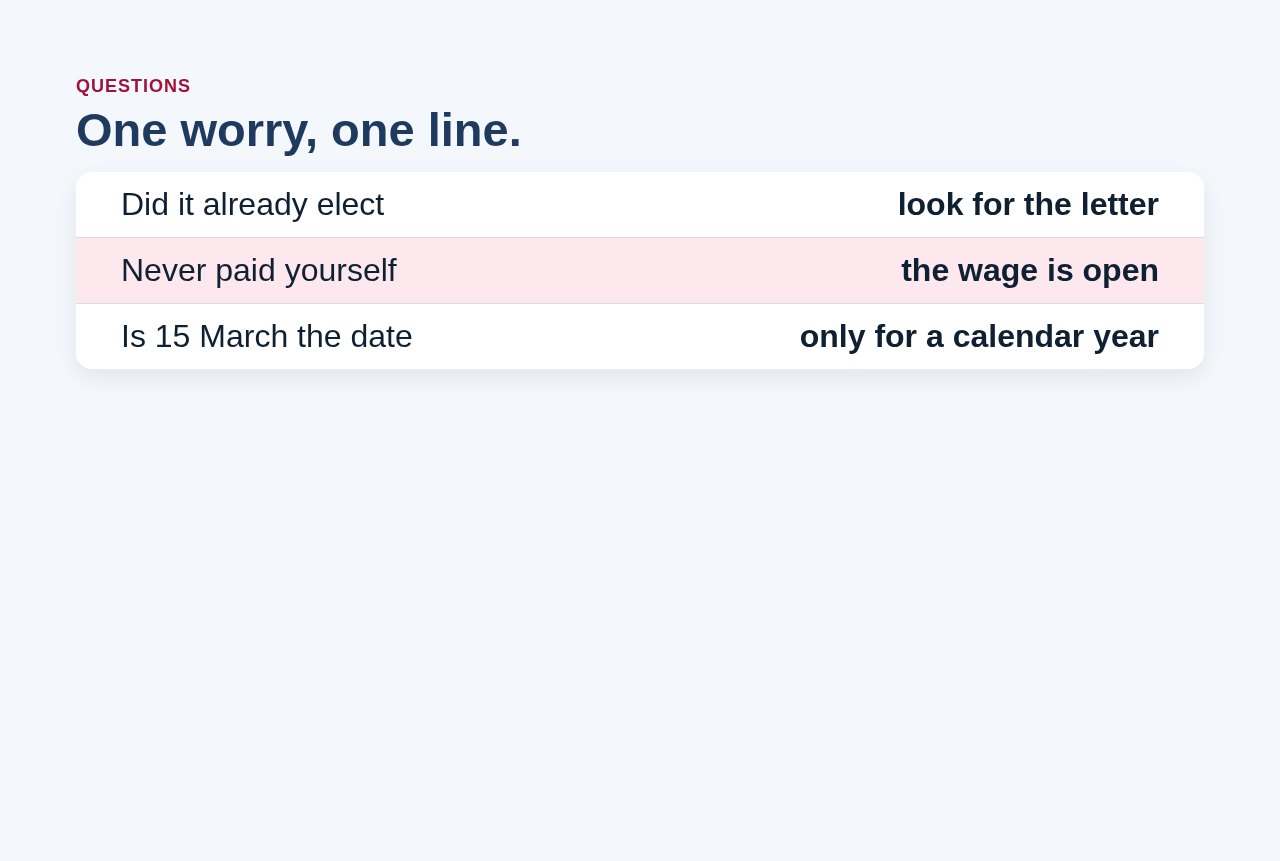
Did the company already elect.
Click to see the election ›Tap to see the election ›
Look for a signed Form 2553 and an acceptance letter. If you have both, the election happened and the work is keeping the list true. If you have neither, the election may never have been filed, and the first work is finding out. A former preparer's assurance is a lead, not a copy. The election page says how the date works for a calendar-year company.
Can my partner own shares with me.
Click to see a partner ›Tap to see a partner ›
A partnership does not hold the stock of an S corp. Two people can each own shares in their own names. A partnership entity on the cap table is one of the breaks. If the other owner is a person, ask the who-may-own page about the count and about one class of stock. If the other owner is a company or a fund, stop and write to us before the shares move.
What if I never paid myself.
Click to see no wage ›Tap to see no wage ›
Then the wage requirement is the open item. A draw is not a wage. We can still talk about whether a wage can be set for the year you are in. We will not promise that a year of unpaid work can be repaired by a single check in December. If a payroll report exists, bring it. If none exists, say so in the note.
Is 15 March my date.
Click to see the date ›Tap to see the date ›
It is the date for a company that keeps the calendar year. A different fiscal year uses the 15th day of its own third month. An extension moves the filing day and does not close the months. If you do not know which year the company keeps, that is the first fact to find. The March page walks the rest of the list that has to be true before the return leaves.
Can I take the money whenever I want.
Click to see a draw ›Tap to see a draw ›
You can take a distribution when basis supports it and when the other owners of the same class are treated in proportion. You cannot treat every transfer as a distribution and skip the wage. Basis falls when the distribution is made. A transfer larger than basis is a number we write down in the month the bank shows it. The distributions page is where that tally is explained without turning it into a March project.
Who answers.
Click to see who answers ›Tap to see who answers ›
Steven Palmieri is the person who writes the reply, working as the Tax CFO. The practice is one practice. The note reaches the same person who would be on the video. We do not hand the requirements list to a room of callers. If a signed cover is what a bank wants, we say that work is outside this site before a scope is written.
What the first reply will name.
Click to see the reply ›Tap to see the reply ›
The reply names one paper. Acceptance letter, payroll report, owner list, or the last month that matches the bank. If the paper is missing, the reply says so, and the search is the work before any recommendation.
A reply will not quote a wage, a basis number, or a filing date for your company. Those belong to the file, and the file is not on this page. The pages name the list a calendar-year company has to keep. They do not measure your cap table.
When the answer is a stop.
Click to see a stop ›Tap to see a stop ›
Some notes describe a company that has already left the list. An owner the statute does not allow, a second class, or a count over the cap. The honest reply is a stop, not a year of monthly closes that pretend the election is still alive. The first reply names a missing paper, so March is not when you hear about it.
A stop is still an answer. It tells you the requirement that failed and the kind of help this site does not provide. Disclosures is where the stop is written out with the statute sections. The phone reaches the same person who would have written the reply.
Ask the requirement in your own words.

You will be talking to the Steven Palmieri practice.