S Corp Requirements AlternativeWhat breaks the election.
A new owner, a side letter, or a fear that the election already ended.
See the break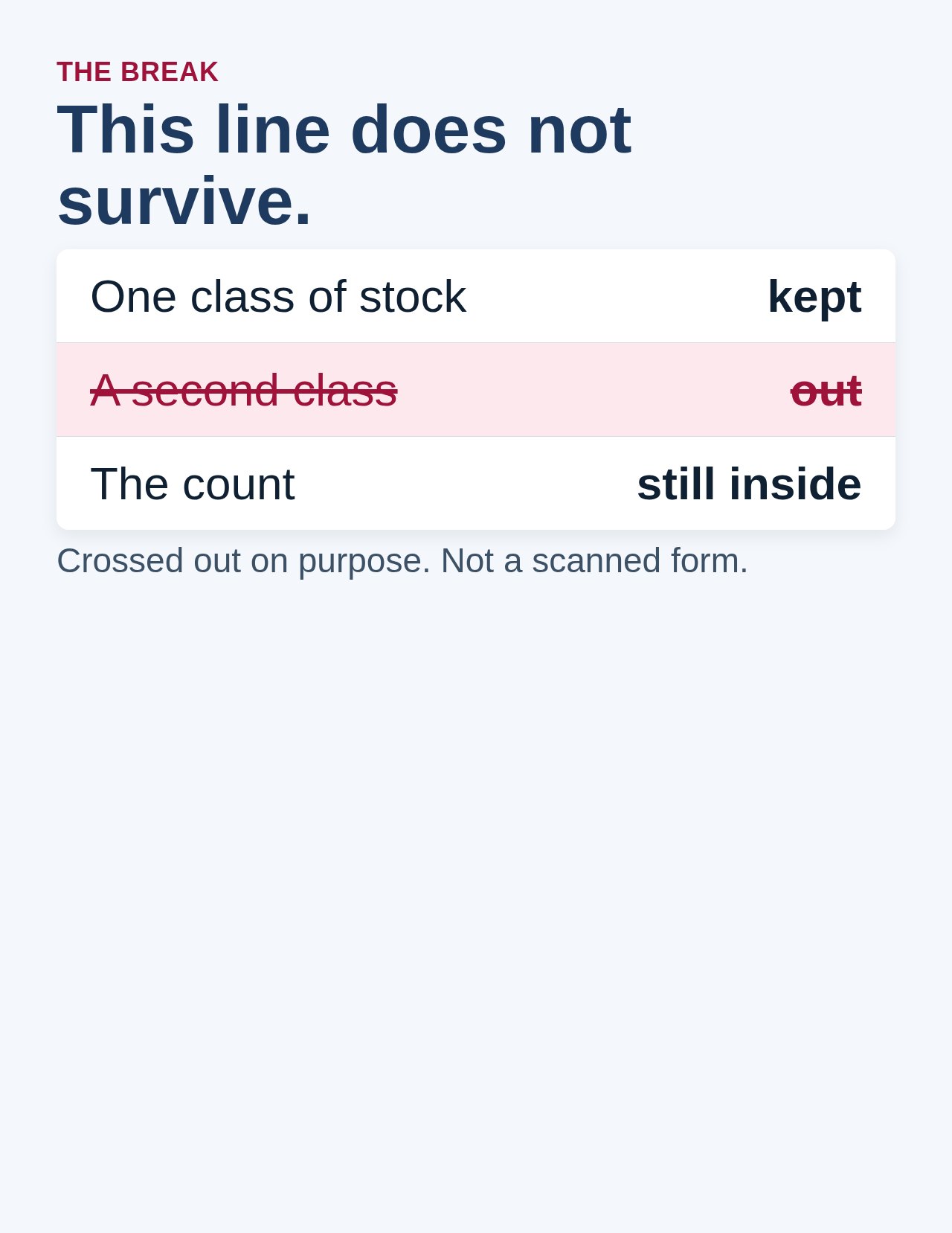
The election fails in ordinary months.
Click to see the break ›Tap to see the break ›
You signed a side letter in the spring and now you are afraid the election ended that day. An election rarely breaks in a dramatic hour. It breaks when a new owner is the wrong kind of owner, when a side letter creates a second set of money rights, or when the shareholder count passes the cap. Each of those can happen in a month when nobody is thinking about the return. The requirements work is the habit of noticing them then. A review that starts on 1 March is a review that hopes nothing happened.
Revocation is the ending you choose. It has consent rules and a timing rule for which year it applies to. We treat a revocation as a decision with a year attached, not as a sentence in a meeting. If you want the company to stop being an S corp, we write the year and the consents before anything is filed. If you do not want that, we watch the list so a break does not arrive uninvited.
What a break does to the year.
Click to see the year ›Tap to see the year ›
When the company ceases to qualify, the year can split into the part that was still an S year and the part that was not. That split has its own returns. We do not summarize it as a small correction. Owners who have been taking distributions and wages under the election need to know the election is the thing that changed. We will say that in plain words after we have read the date the qualification failed.
Some failures have published relief, and some do not. We will not advertise relief as the likely end. We will tell you, once the fact is on the table, whether a relief filing is a real option or whether the year has to be reported as the statute already requires. We will not treat a hope as the filing position.
The papers that warn you.
Click to see the papers ›Tap to see the papers ›
The cap table, the side letters, the payroll register, and the labeled draws are the warning papers. None of them is optional if you want the election to be boring. Boring is the goal. A boring election is one that still meets the list in December because somebody checked it in April, July, and October. The shredded page on this site is the picture of a file that was not kept. We would rather keep the file.
A buyer or a lender will ask for the acceptance letter and for proof the company never stopped qualifying. If the monthly file exists, that conversation is short. If it does not, the sale or the loan waits on a reconstruction. Reconstruction is more expensive than the habit, and it is less certain. That is the practical reason the list is monthly.
Say what changed.
Click to see the change ›Tap to see the change ›
The useful note says what changed. A new owner, a new class, a revoked election, or a fear that one of those happened. You do not need the legal name of the failure. You need the fact. We will match the fact to the requirement it touches and tell you whether this practice can keep going on the list or whether the company has already left it.
If the company has left it, we will not sell you a year of monthly closes that pretend otherwise. You can leave the first call with a named stop and no engagement. Naming that stop is the work of the call. A practice that cannot say stop is a practice that will file the wrong return to keep the engagement.
Name the paper you are holding.

You will be talking to the Steven Palmieri practice.